When the Desert Was Underwater
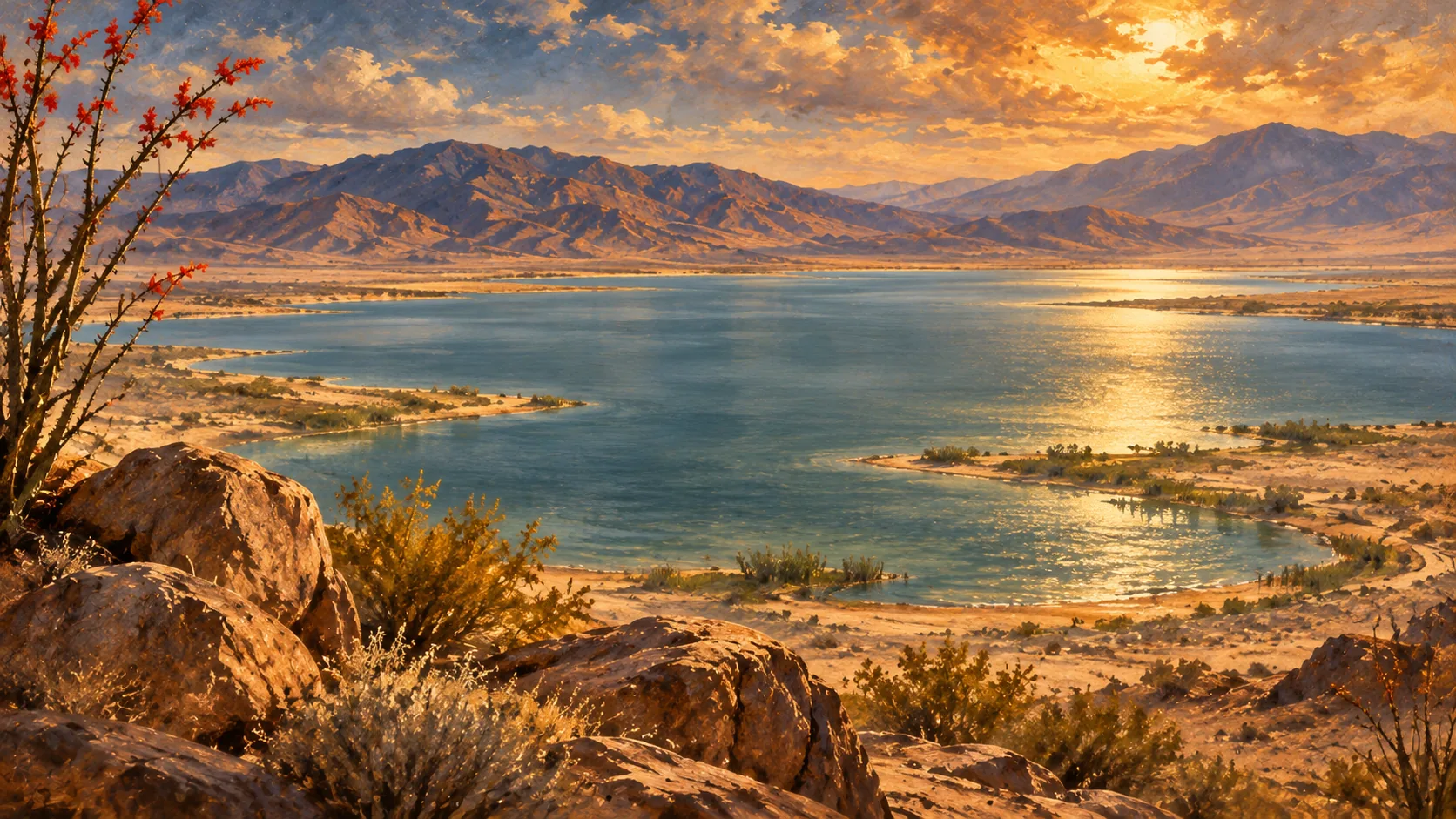
Imagine standing along the shores of the Salton Sea and looking across the surrounding desert. Beyond the water lie dry valleys, rugged mountains, and miles of sunbaked earth.
Now imagine that much of this landscape was once covered by an enormous freshwater lake.
It sounds almost as improbable as finding a ship in the desert.
Yet the lake was real.
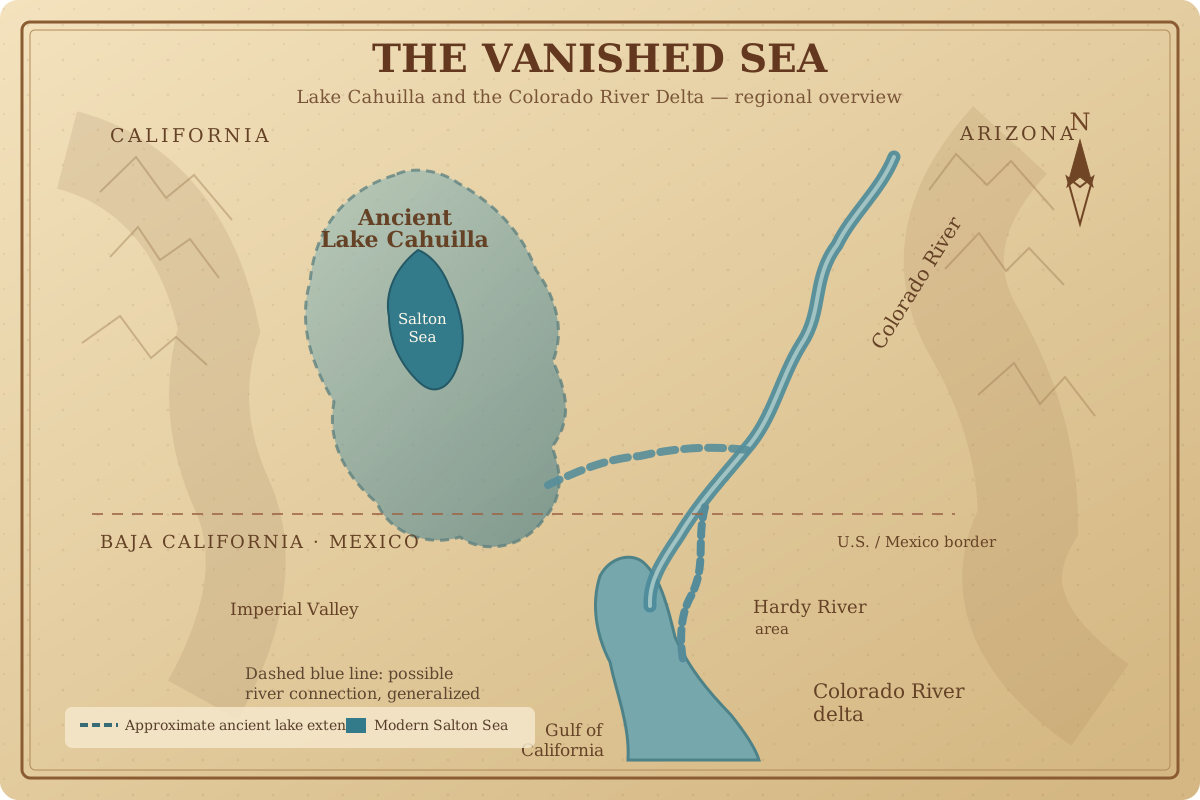
Known today as Lake Cahuilla, this ancient body of water periodically filled the Salton Basin of Southern California, extending far beyond the shores of the modern Salton Sea.
Its waters occupied areas that are now desert communities, agricultural fields, and dry lakebeds.
And unlike the legendary ship, Lake Cahuilla left behind unmistakable evidence of its existence.
A Lake That Came and Went
The lake's remarkable history begins with the Colorado River.
Over the centuries, the river changed course as it flowed toward the Gulf of California. Sometimes its waters traveled southward through the delta. At other times, they were diverted northwest into the low-lying Salton Basin.
When that happened, the basin gradually filled, creating a vast inland lake.
When the river returned to its southward course, the lake lost its principal source of water and began to shrink through evaporation.
This cycle occurred repeatedly over many centuries, with Lake Cahuilla filling the basin as late as the seventeenth century.
Today, ancient shorelines, sediment deposits, and archaeological evidence help researchers reconstruct the lake's changing boundaries.
The desert, it turns out, has not always looked the way it does today.
A Passage from the Gulf?
Here is where the history becomes particularly interesting.
When Lake Cahuilla reached its highest levels, excess water could flow southward through the Hardy River system toward the Colorado River delta and the Gulf of California.
This raises an intriguing possibility.
Could a vessel traveling north from the Gulf have followed these waterways into the inland lake?
According to archaeological researcher Don Laylander, a shallow-draft vessel might have been able to navigate such a route when conditions were favorable.
That does not mean a Spanish galleon made the journey. The waterways would have presented challenges, and their navigability depended upon changing conditions.
But the possibility of a waterborne route into the Salton Basin gives the legend a geographical setting that is more plausible than it first appears.
The Shoreline Disappears
Imagine a vessel entering the lake during a period of high water.
Years later, as the Colorado River changed course and the lake began to recede, its crew might have found themselves navigating increasingly shallow waters.
Eventually, a stranded vessel could have been abandoned along the retreating shoreline.
Over time, the lakebed would dry, winds would move sand across the landscape, and the remains of a wooden ship might become increasingly difficult to locate.
It is an intriguing scenario.
But it remains hypothetical.
No authenticated discovery has established that the legendary ship entered Lake Cahuilla or was abandoned along its shores.
What we can say is that the landscape once contained the enormous body of water described in many versions of the legend.
And that fact alone makes the mystery worth investigating.
Following the Trail
The ancient lake may help explain how a vessel could have reached the desert.
But what about those who claimed to have seen one?
For more than a century, travelers, prospectors, and treasure hunters have reported strange discoveries among the salt flats and shifting sands.
Some even organized expeditions to find the mysterious wreck.
Sightings & SearchesHistorical Sources
- Don Laylander, “Early Strangers on the Lower Colorado River and in the California Deserts: The Factual, the Implausible, and the Problematic.” Pacific Coast Archaeological Society Quarterly, Vol. 56, No. 1, 2021, pp. 25–39. Particularly the discussion of Lake Cahuilla, the Hardy River, and the possible navigation of shallow-draft vessels.
- Don Laylander, “The Last Days of Lake Cahuilla: The Elmore Site.” 1997. Additional research on the lake's late history, identified in Laylander's bibliography; not independently reviewed for this draft.