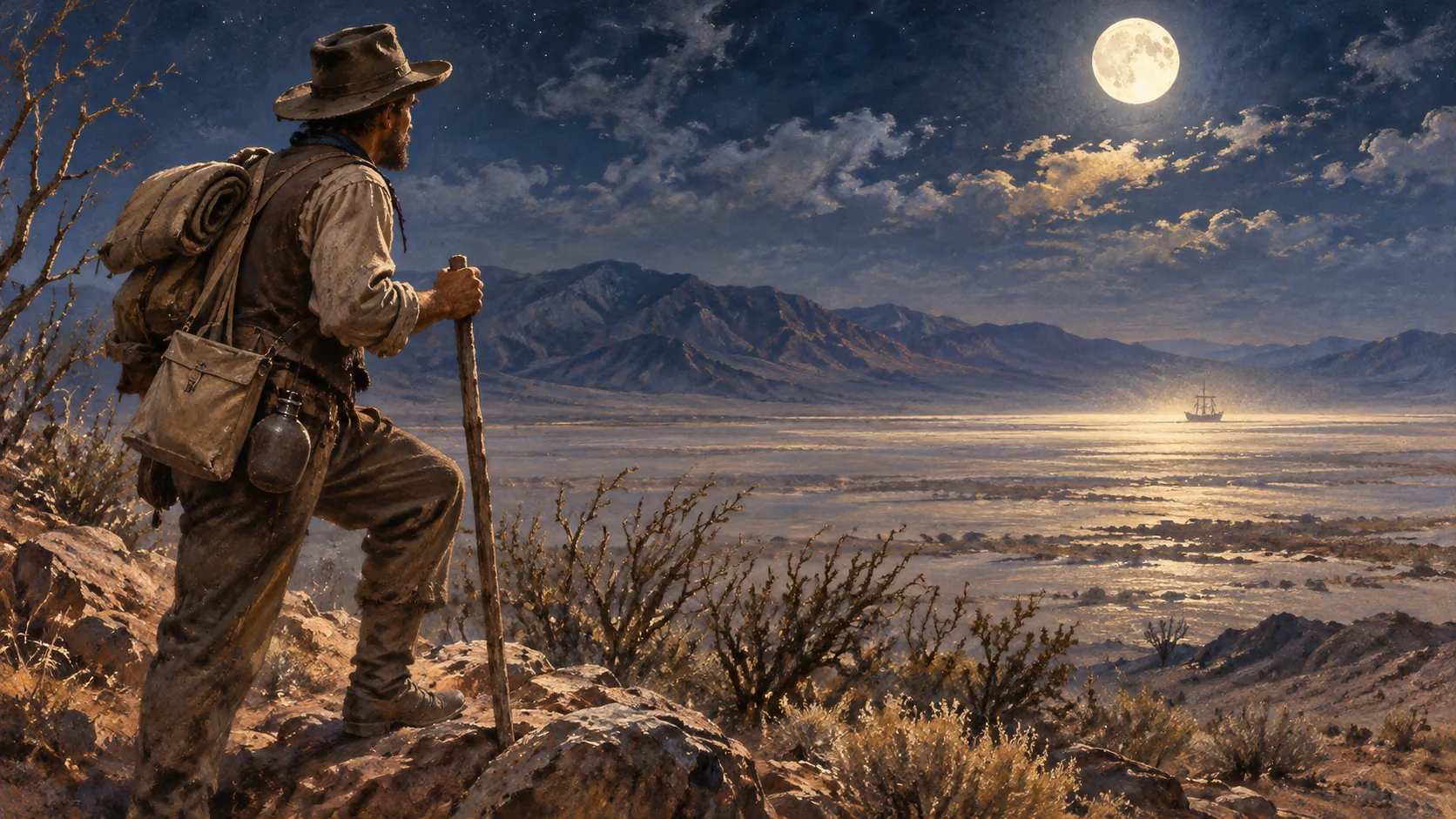
A Strange Sight in the Moonlight
In the summer of 1863, Albert S. Evans was making his way across Southern California's Colorado Desert after a difficult journey to Arizona.
His horse had died. His boots were falling apart. And ahead lay miles of scorching sand, salt flats, and barren mountains.
At a desert watering place called Dos Palmas, a man helped Evans repair his boots and gave him socks to protect his injured feet. After resting, Evans resumed his journey shortly after midnight, hoping to cross the desert before the worst of the day's heat.
Around two o'clock in the morning, he reached a rise overlooking a vast, pale expanse.
The full moon illuminated the salt flats below, transforming the dry landscape into what appeared to be a shimmering inland sea.
And there, far out across the moonlit plain, Evans noticed something extraordinary.
In his account, he described:
“...the wreck of a gallant ship, which might have gone down there centuries ago...”
He imagined that such a vessel might have belonged to Spanish adventurers who had ventured into the region long before his own journey.
But Evans did not approach the object, identify a ship, or report finding any physical remains. His description was of something seen at a distance, under moonlight.
Was it an actual wreck? A distant rock formation? An illusion created by the unusual landscape?
His account offers no definite answer.
From Observation to Legend
Seven years later, in January 1870, Evans published his experience in an article titled In the Valley of the Shadow, appearing in the literary magazine The Galaxy.
It is among the earliest identified published references associated with the Lost Ship of the Desert.
During that same year, newspaper stories began circulating about a mysterious vessel supposedly discovered in the Colorado Desert. Prospectors and other searchers would soon become part of the unfolding tale.
Whether those reports grew directly from Evans's description, reflected older stories already circulating in the region, or represented separate incidents remains uncertain.
But by the end of the nineteenth century, the mysterious ship had become much more than a distant shape on a moonlit salt flat.
It had become a legend.
Following the Trail
Evans's account leaves us with an intriguing question: What did he actually see?
To answer it, we must look beyond his description to the stories that followed—accounts of Spanish vessels, pearl hunters, buried treasure, and expeditions searching for a ship that seemed to disappear whenever someone tried to find it.
Ships & TreasureHistorical Source
Albert S. Evans, “In the Valley of the Shadow,” The Galaxy, Vol. 9, No. 1, January 1870, pp. 89–93. The description of the apparent shipwreck appears on page 90.